Bhoomi RTC & i-RTC Meaning: Download a Bank-Valid Pahani (Karnataka)
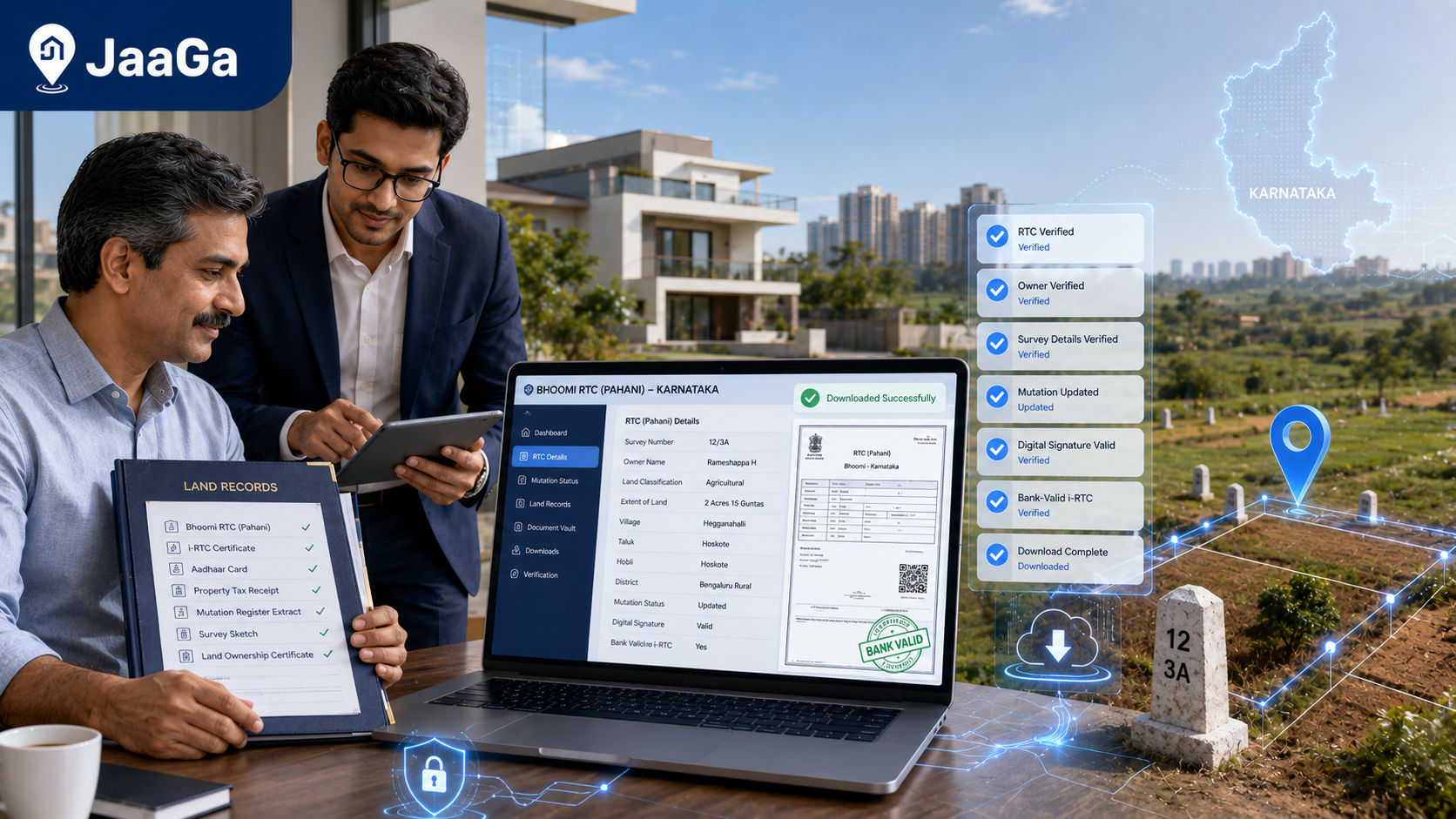
If you own land in Karnataka, or you are about to buy some, the RTC is the single document you will be asked for most often. It is also the document most people misunderstand.
The confusion usually shows up at the worst possible moment. A buyer downloads a clean-looking RTC from the Bhoomi portal, brings it to the bank for a home loan, and gets told it cannot be used. The document was real. The information on it was correct. It still was not accepted.
This guide covers what an RTC actually is, how to read every field on it, how to pull yours from the Bhoomi portal, and the difference between the free copy anyone can view and the digitally signed version that carries legal weight.
What is Bhoomi, and what is an RTC?
Bhoomi is the Government of Karnataka's land records system. Karnataka was the first state in India to digitise its land records at scale, and the Bhoomi programme is what replaced the old handwritten village registers that sat with the Village Accountant.
RTC stands for Record of Rights, Tenancy and Crops. In Kannada it is called the Pahani (ಪಹಣಿ). These are not two different documents. They are two names for the same record, and you will see both used interchangeably by banks, lawyers, and government offices.
The RTC is maintained by the Revenue Department and is the primary ownership record for agricultural land in Karnataka. When people search for a Bhoomi land RTC, this is the document they mean. It tells you who holds the land, how much of it there is, what kind of land it is, what has been grown on it, and whether any loans are registered against it.
One point that saves people a lot of wasted effort: the RTC applies to agricultural land. If your property is a flat, a site, or a building inside city limits, the RTC is not your ownership document. You need a Khata. We cover that distinction further down.
What is actually inside an RTC?
Most guides tell you how to download the RTC and stop there. That is not much use if you cannot read it. Here is what each part of the document is telling you.
Download a bank-valid Bhoomi i-RTC
The free RTC won't pass at the bank. JaaGa fetches the digitally signed, bank-valid i-RTC for any Karnataka survey number.
Download Bank-Valid i-RTC →Survey Number, Surnoc and Hissa
The Survey Number identifies the parcel of land. Over generations, a single survey number gets divided among heirs and buyers, and those subdivisions are tracked as Hissa numbers. Surnoc is a further classification within the survey record.
This matters when you are buying. If the seller shows you an RTC for Survey No. 42 but the land you are standing on is Survey No. 42/3, you are looking at the record for a different piece of land, possibly one belonging to a different member of the family.
Owner name and extent
The owner column lists the person or people recorded as holding rights over the land, along with the extent each one holds, measured in acres and guntas.
Look closely at whether there are multiple names. Ancestral agricultural land very often has four or five names on the RTC, and every one of them may need to sign at the time of sale. A single-name RTC and a five-name RTC are very different transactions.
Land classification and soil type
The RTC records whether the land is dry, wet, or garden land, along with soil classification. This affects valuation, what you are permitted to build, and whether conversion to non-agricultural use is realistic.
Crop details
The RTC carries a season-by-season record of what has been cultivated. This is the "Crops" part of Record of Rights, Tenancy and Crops. It is often ignored by buyers, but it is useful evidence of who has actually been in possession of the land, which is not always the same as who is named on the paper.
Khata number and mutation entries
The Khata number links the land to the revenue records for tax purposes. The mutation entries (MR numbers) are the transaction history. Every time the land changed hands through sale, inheritance, gift, or partition, a mutation should have been recorded.
This is the section to read most carefully. A gap in the mutation chain means an ownership change happened that was never properly recorded, and that gap is exactly the kind of defect that surfaces years later as a title dispute.
Liabilities and loan entries
If a loan has been taken against the land, it should appear here. An RTC showing an active charge means the land is already pledged. Never rely on the seller's word about this. Read it on the record, and cross-check it against an Encumbrance Certificate.
How to view your RTC on the Bhoomi portal
The Bhoomi RTC view is free and does not require an account.
- Go to the official Bhoomi land records portal at landrecords.karnataka.gov.in. Be careful here, because this is where most people go wrong. Searches like "bhoomi online rtc", "rtc bhoomi online" and "bhoomi com rtc" surface a long list of private sites with names built to look official. There is no government site at bhoomi.com. The only official source is the state domain, so check that the address ends in
.karnataka.gov.inbefore you enter a survey number or pay anything. - Open the RTC service. From the services list, choose the option to view RTC and MR (Mutation Register). The same portal also offers Khata Extract, Akarband, Survey Documents, Survey Sketch, eChavadi, and Record Room Documents.
- Select your location. You will work down a chain of dropdowns: District → Taluk → Hobli → Village. Hobli is the administrative unit between taluk and village, and it trips people up. If you do not know yours, your sale deed or an older RTC will name it.
- Enter the land identifiers. Fill in the Survey Number, then Surnoc and Hissa number. The portal narrows these based on what exists in the village record, so if your Hissa number does not appear in the list, the subdivision may never have been recorded.
- Choose the period or year. You can pull the current RTC or older years. Historical RTCs are genuinely useful when you are verifying a chain of ownership, because they show you who was recorded as owner at each point in time.
- View the record. The RTC is displayed on screen and can be printed or saved.
What you have at this point is a viewing copy. It is accurate, and it is fine for your own research. It is not the version to hand to a bank.
Can you search Bhoomi RTC by owner name?
This is one of the most common questions about the portal, and a lot of the answers floating around are wrong.
Plenty of private sites claim you can pull a Bhoomi RTC by owner name. Be careful with that advice. The official RTC service on the Bhoomi portal is built around land, not people. The fields it asks for are district, taluk, hobli, village, survey number, surnoc, hissa and period. There is no name field in that flow. If you have only a name and no survey number, the standard RTC lookup will not get you there.
There is a reason the record works this way. A name is not a unique identifier. Villages routinely have several people with the same name, spellings vary between records, and land held jointly may be recorded under one family member. The survey number identifies exactly one parcel. A name does not.
What to do if you only have the owner's name
- Check the property documents first. The survey number, hissa and village are printed on the sale deed, on older RTCs, on the Khata, and on tax receipts. This is the fastest route by a wide margin.
- Use the Encumbrance Certificate. Karnataka's registration system (Kaveri) is organised around registered transactions, and searching for a person's registered dealings is a more realistic path than searching the RTC. An EC search can surface the property details, which then give you the survey number to run against Bhoomi. Our Encumbrance Certificate guide explains how that search works.
- Ask at the village level. The Village Accountant and the taluk office hold the village records and can identify a parcel from a name plus a locality. It is not instant, but it works when nothing else does.
- Use the village map or survey sketch. If you can identify the land physically, the village map and Mojini survey sketch let you work backwards from location to survey number.
Once you have the survey number, the normal RTC lookup takes a couple of minutes.
Practical note: if someone offers to run a "Bhoomi RTC by owner name" search for a fee, be cautious. Confirm what they will actually deliver before paying, because the underlying record is not indexed by name.
Why the free RTC often is not accepted
The copy you view and print from the portal has no digital signature on it. Because it is an unsigned print of a web page, there is nothing on the document that proves it came from the government system rather than from an image editor.
In practice, that means lenders, courts, and registration offices will usually ask for the digitally signed version instead. Situations where the free copy tends to get rejected include:
- Home loan and agricultural loan applications
- Property registration at the Sub-Registrar's office
- Court proceedings and title disputes
- Land conversion applications
- Government subsidy and compensation claims
People often discover this late. The loan file has already been submitted, the RTC comes back rejected, and the application stalls while the correct document is arranged. It is a small step that is easy to get right at the start.
How to get the digitally signed i-RTC
The i-RTC (you will also see it written as i RTC) is the digitally signed version of the same record. It carries a government digital signature and a QR code, which lets anyone receiving it verify the document against the source system rather than taking it on trust.
The Bhoomi portal links directly to it. On the RTC service page there is an option along the lines of "get the original digitally signed RTC and MR", which takes you into the signed-document flow.
The i-RTC requires a small fee, in the range of ₹10 to ₹15 per document, paid online. You will need the same details you used for the free view: district, taluk, hobli, village, survey number, surnoc and hissa. Once payment goes through, the signed PDF is available for download.
Two things worth knowing:
- Keep the PDF, not a printout. The digital signature and QR code are properties of the electronic file. Print it and you lose the part that makes it verifiable. Send the PDF wherever possible.
- Check the signature validates. Open the file in a PDF reader and confirm the signature panel shows it as valid. If it does not, the download did not complete cleanly and you should pull it again.
Common problems, and what they usually mean
- The name on the RTC is not the current owner. This almost always means a mutation was never recorded after the last sale or inheritance. The transaction may have been perfectly legitimate, but until the mutation is entered, the revenue record still points at the previous owner. It has to be corrected before the land can be cleanly transferred again.
- The survey number exists but your hissa does not. The subdivision was never formally recorded. This is common with land divided informally among family members, and it needs a survey and formal subdivision to resolve.
- The extent on the RTC does not match the ground. Differences between the recorded extent and the actual measured area are common in older records. A physical survey establishes what is really there, and the gap between the two is a negotiating point at minimum, a serious problem at worst.
- An old loan still shows as an active charge. The loan may well have been repaid years ago without anyone filing the release. It still sits on the record and will block a sale until it is cleared.
- You cannot find any RTC for your property. If the property is inside city limits, there may be no RTC to find, because it is not agricultural land. See the next section.
RTC, Khata and EC: which one do you actually need?
These three get mixed up constantly, and asking for the wrong one wastes weeks.
RTC (Pahani) is the ownership and cultivation record for agricultural land, maintained by the Revenue Department.
Khata is the municipal record that ties a property to the local body's tax rolls. For property inside Bengaluru city limits this is the BBMP Khata, now issued in electronic form as e-Aasthi. Khata is what applies to sites, flats and buildings. We have covered this in detail in What Is a Khata in Bangalore and in the Karnataka Khata extract guide.
Encumbrance Certificate (EC) is a different thing entirely. It is not an ownership document. It is the transaction history registered against a property over a period, and it is what reveals mortgages, sales and other charges. See the Encumbrance Certificate guide.
A useful way to hold it: the RTC and Khata tell you who holds the property. The EC tells you what has been done to it. Verifying a property properly means reading all of them together, not picking one. Our guide on how to prove legal ownership of a property walks through how these documents corroborate each other.
Before you rely on an RTC
An RTC confirms what the revenue record says today. It does not, on its own, confirm that the title is clean.
A property can have a perfectly ordinary-looking RTC and still carry an unrecorded family claim, a break in the mutation chain, a boundary that does not match the survey sketch, or a charge that was cleared but never released. Those are found by reading the RTC alongside the EC, the mutation history, the survey records and the parent documents, and by having someone who knows what a defect looks like read them together. A title verification and legal opinion is what turns a pile of documents into an answer.
Need your Karnataka records without fighting the portal? JaaGa pulls certified RTC, Khata extracts and ECs across Karnataka and other states, and can put a full property audit report behind them. See what we cover in Karnataka.
Download a bank-valid Bhoomi i-RTC
The free RTC won't pass at the bank. JaaGa fetches the digitally signed, bank-valid i-RTC for any Karnataka survey number.
Download Bank-Valid i-RTC →Need Help with Property Records and Document Verification in Karnataka?
Handling property transactions, pulling records, and verifying title records can be complex and time-consuming. JaaGa offers a professional, reliable, and entirely online solution to handle document verification, EC retrieval, and title audits for buyers, owners, and NRI investors.
Get in Touch with JaaGa SupportFAQs
Related Articles
Download your Pattadar Passbook (ePPB) on Bhu Bharati, get a duplicate, fix errors and appeal a rejection. Step-by-step for Telangana landowners, 2026.

Telangana revised property market values from 5 June 2026. How to check the new land and apartment rates on the IGRS portal, how they are calculated, and what they mean for your stamp duty.
.png?tr=w-600,q-80,f-auto)
What is Patta Chitta? How to view and download your Tamil Nadu Patta Chitta online at eservices.tn.gov.in — by patta number, name or survey number, plus how it differs from an EC.
Explore All Insights

Telangana has ordered a fast-track review of pending Urban Land Ceiling applications. What ULC land is, why it blocks registration, and what owners should do.
What property tax is, how Andhra Pradesh calculates it, what your city charges, and how to get your AP property tax receipt as a soft copy from JaaGa.

Telangana now allows registration of 22-A listed plots, houses and flats with valid GHMC, HMDA or DTCP approvals. The link-document rule and how to apply.
Andhra Pradesh has reopened registration for about 9 lakh acres of freehold land. What changed, which lands are still barred, and how to check yours.
Download your Pattadar Passbook (ePPB) on Bhu Bharati, get a duplicate, fix errors and appeal a rejection. Step-by-step for Telangana landowners, 2026.
Telangana revised property market values from 5 June 2026. How to check the new land and apartment rates on the IGRS portal, how they are calculated, and what they mean for your stamp duty.
Current Telangana stamp duty, transfer duty and registration fee for sale, gift, GPA, mortgage, lease, partition, will and settlement deeds. Verified against IGRS.
What is Patta Chitta? How to view and download your Tamil Nadu Patta Chitta online at eservices.tn.gov.in — by patta number, name or survey number, plus how it differs from an EC.
%20What%20Every%20Homeowner%20Must%20Know%202026.png?tr=w-600,q-80,f-auto)
Andhra Pradesh is issuing QR-coded property cards under the NAKSHA drone + GIS survey. See what's on the card, the first 10 cities, the March 2027 timeline, and what to do now.

Learn how to find and locate property ownership, verify the title chain, check the right records, and spot red flags before you buy property in India.

Learn how to change the electricity bill name in Hyderabad, what documents TGSPDCL asks for, how the process works, and what to do if bills or arrears are pending.

Learn how to check 22A prohibited land in Telangana, cross-check Bhu Bharati and registration records, and avoid buying property that cannot be registered.
.png?tr=w-600,q-80,f-auto)
தமிழ்நாட்டில் நிலம் வாங்குவது அல்லது விற்பது, அல்லது உங்கள் சொத்தின் மீதான உரிமையை உறுதிப்படுத்துவது ஒரு சிக்கலான செயல்முறையாக இருக்கலாம், குறிப்பாக சரியான ஆவணங்களைப் பற்றிய தெளிவு இல்லாதவர்களுக்கு. இந்த செயல்முறையின் மையத்தில் தமிழ்நாடு நில ஆவணங்கள் உள்ளன.
ಕರ್ನಾಟಕದಲ್ಲಿ ಆಸ್ತಿ ಮಾಲೀಕರಿಗೆ ಮತ್ತು ಆಸ್ತಿ ವ್ಯವಹಾರಗಳಲ್ಲಿ ತೊಡಗಿರುವವರಿಗೆ Khata Extract ಒಂದು ಅತ್ಯಗತ್ಯ ದಾಖಲೆಯಾಗಿದೆ. ಇದು ಆಸ್ತಿಯ ಮಾಲೀಕತ್ವ, ವಿವರಗಳು ಮತ್ತು ತೆರಿಗೆ ಪಾವತಿ ಸ್ಥಿತಿಯ ಬಗ್ಗೆ ನಿರ್ಣಾಯಕ ಮಾಹಿತಿಯನ್ನು ಒದಗಿಸುವ ಒಂದು ಪ್ರಮುಖ ಆಸ್ತಿ ದಾಖಲೆಯಾಗಿದೆ. JaaGa ದಂತಹ ವೇದಿಕೆಗಳು ನಿಮಗೆ ಹೇಗೆ ಸಹಾಯ ಮಾಡುತ್ತವೆ ಎಂಬುದನ್ನು ತಿಳಿಯಿರಿ.
Access Maharashtra property and land records online with Jaaga. Download Property Card, 7/12 Utara, Ferfar, 8A Extract, Bhunaksha, Village Map, CTS Maps, Encumbrance Certificate, RERA details, and more. Fast, secure, and verified document delivery.
Learn how to research land in Telangana before buying or investing. Discover land records, ownership verification, encumbrance certificates, survey details, legal checks, and expert tips to avoid property disputes.

Discover 15 critical red flags in property documents every lawyer must verify before issuing a title opinion. Learn how modern legal teams handle property due diligence.
.png?tr=w-600,q-80,f-auto)
Learn how a title search report and legal opinion help panel lawyers verify ownership, detect encumbrances, reduce legal risks, and ensure secure property transactions.
.png?tr=w-600,q-80,f-auto)
Supreme Court flags institutional failure as RERA becomes a shield for defaulting builders, not homebuyers. Learn about the challenges.
.png?tr=w-600,q-80,f-auto)
Learn how to download Telangana EC, Land Records, RoR & Pahani instantly using the Jaaga App. Understand document importance, when they are required, and how to access them easily online.
.png?tr=w-600,q-80,f-auto)
Learn why the Telangana government is replacing the GHMC Act with a new Core Urban Act (CURE), how it will affect Hyderabad’s civic administration and urban development.
.png?tr=w-600,q-80,f-auto)
Learn everything about the Encumbrance Certificate (EC), its importance in property transactions, and how to download it online in states like Telangana, AP, Tamil Nadu, and Odisha.
A Certified Encumbrance Certificate (EC) records all property transactions. Learn how to download your Certified EC in Telangana using JaaGa.
Understand the difference between Adangal, ROR, and 1B documents, their importance, and how to download Adangal and 1B online. A complete guide for landowners and farmers.
.jpg?tr=w-600,q-80,f-auto)
Learn how to view, download, and verify your FMB Sketch or FMB Map Online in Tamil Nadu. Step-by-step guide to accessing the Tamil Nadu Map, downloading FMB records, and checking land details easily.
.jpg?tr=w-600,q-80,f-auto)
Discover essential real estate investment tips for 2026! Learn to select investment properties wisely and thrive in the evolving market landscape.
.jpg?tr=w-600,q-80,f-auto)
Bhu-Aadhaar or ULPIN (Unique Land Parcel Identification Number) is a 14-digit digital ID for every land parcel in India under DILRMP. Learn its meaning, generation process, benefits, and state-wise implementation.
.jpg?tr=w-600,q-80,f-auto)
Learn what is sale deed and what is sale agreement, their meanings, differences, types, and legal importance in property transactions. Discover what a link document is and why it matters.
.jpg?tr=w-600,q-80,f-auto)
Thinking of buying property in your parents’ name in India? Read this first to understand legal pitfalls, tax impacts, inheritance issues, and smarter strategies before you decide.
.jpg?tr=w-600,q-80,f-auto)
Discover how Title Verification & Legal Opinion protects your property investment. Learn the documents required, what’s included in the report, and why it’s essential for safe real estate transactions.
.jpg?tr=w-600,q-80,f-auto)
Bhu Bharati Portal Scam: Telangana’s ₹52-Crore Digital Fraud Unraveled
The Bhu Bharati portal scam in Telangana has snowballed into a ₹52-crore cyber fraud, revealing deep corruption, forged e-challans, and technical loopholes in India’s land registration systems. Here’s a full breakdown of how it unfolded — and what it means for digital governance.
.jpg?updatedAt=1768798124056&tr=w-600,q-80,f-auto)
A simple guide explaining A Khata, B Khata, eligibility, benefits, and conversion rules in Bangalore.
.jpg?tr=w-600,q-80,f-auto)
Learn how to easily download your Maharashtra 8A (Agriculture) document online using JaaGa. Follow our simple guide to enter your Village/Division and Survey Number to get your 8A extract instantly. Fast, free, and accurate!
.jpg?tr=w-600,q-80,f-auto)
Learn how to download your Maharashtra Property Card using the JaaGa App with a detailed step-by-step guide. Find out how to enter Village/Division, Survey Number, and more.
.jpg?tr=w-600,q-80,f-auto)
In today’s interconnected world, property transactions often involve multiple languages, legal systems, and institutional requirements. Whether you are buying property in a different state, submitting documents to banks, or dealing with government offices for registration or compliance, accurate translation of property documents is essential.
.jpg?tr=w-600,q-80,f-auto)
Get a clear understanding of what is a legal opinion, why it’s vital for property buyers, and how to easily request a verified legal opinion using JaaGa.
.jpg?tr=w-600,q-80,f-auto)
Odisha land records are essential for landowners, buyers, and researchers. One of the most important documents is the Plot Map / Bhunaksha, which shows the geographic layout of land parcels. With the JaaGa portal, you can download the Odisha plot map quickly, simply, and for free — all online!
.jpg?tr=w-600,q-80,f-auto)
Learn how to easily download your Karnataka Khata Extract online using the JaaGa portal. Follow our complete step-by-step guide using your Village/Division and Khata Number to access your property details instantly.
.jpg?tr=w-600,q-80,f-auto)
Buying property in Telangana is a major life milestone, but as recent headlines prove, it can quickly turn into a legal nightmare without the right verification. Learn how to protect yourself from scams.

A Complete Guide for Flats, Villas, and Land Buyers. Learn about RERA, TG RERA, and how a professional property audit report by Jaaga can help you choose the right property with confidence.
.jpg?tr=w-600,q-80,f-auto)
Before registering property in Telangana, learn JaaGa’s expert tips and legal checklist for smooth registration, stamp duty, and document verification. Discover how JaaGa ensures transparent, secure property ownership in Telangana.
.jpg?tr=w-600,q-80,f-auto)
Download Andhra Pradesh Certified Copy online using SRO, document number, and registration year. Legally valid, digitally signed property records via JaaGa.
.jpg?tr=w-600,q-80,f-auto)
Learn how to download the Tamil Nadu FMB Sketch online through the JaaGa platform or the TN e-Services portal. Step-by-step guide with full details on Village/Division, Land Type, Survey Number, and Sub Division Number.
Buying property is one of the most significant investments in a person’s life. Yet, the registration process can often feel like a maze of paperwork, legal jargon, and endless waiting. This is where JaaGa Property Registration Services steps in — providing a one-stop, online registration solution designed to simplify and streamline the entire process.
.jpg?tr=w-600,q-80,f-auto)
Learn what 7 12 Maharashtra land records are, how to check 7 12 online Maharashtra, understand satbara utara Maharashtra, Bhunaksha maps, Ferfar, 8A extract, and how Maharashtra land records work together for safe property transactions.
.jpg?tr=w-600,q-80,f-auto)
Discover how JaaGa automates banking due diligence, eliminates manual verification, accelerates APF and mortgage checks, and delivers fast, accurate property intelligence.
Get accurate, certified property valuation in Hyderabad. Residential, commercial & land valuation for loans, sale, purchase, and legal purposes. Fast & reliable.
.png?updatedAt=1761916011550&tr=w-600,q-80,f-auto)
Mutation is the process of changing the title of a property in the revenue records after it has been sold, inherited, or transferred. In Telangana, the mutation process ensures that the new owner's name is officially registered in government records, allowing them to pay property tax and establish legal ownership.
.png?updatedAt=1758529773318&tr=w-600,q-80,f-auto)
Owning property is one of the biggest financial and emotional investments in India. But proving legal ownership of a property can often be confusing, especially when disputes, missing documents, or unclear records are involved.